Important Notice

By continuing, you agree to our privacy policy, consent to cookies, and confirm you are 21 or older.

I have read and agree to the Privacy Policy and Terms of Service.

YOU MUST BE 21 OR OLDER TO CONTINUE

NYC, Long Island and The Hamptons Receive Free Delivery on Orders $300+

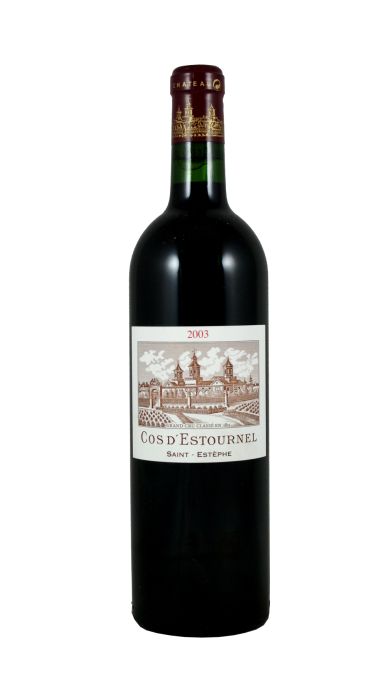
2003 Cos D'estournel

97 RP

Availability:

Critic Reviews

The prodigious, fantastic 2003 Cos d’Estournel is a candidate for “wine of the vintage.” A blend of 68% Cabernet Sauvignon (unusually high for this chateau), 30% Merlot, and 2% Cabernet Franc, 17,500 cases were produced from low yields. An inky/blue/purple color is accompanied by a compelling perfume of black fruits, subtle smoke, pain grille, incense, and flowers. With extraordinary richness, full body, and remarkable freshness, elegance, and persistence, this is one of the finest wines ever made by this estate. The good news is that it will be drinkable at a young age yet evolve for three decades or more. Kudos to winemaker Jean-Guillaume Prats and owner Michel Reybier.

Robert Parker | 98 RP
A dense and powerful wine as always with very ripe fruit yet an underlying freshness and complexity with tobacco, dried fruit and fresh spices such as lemon grass and Thai basil. Layered and long. Drink or hold.

James Suckling | 98 JS
The 2003 Cos d’Estournel is a total knock out. Super-ripe and opulent from the outset, the 2003 is a big, ample Cos that takes over all the senses and never lets up. The bouquet alone – with its alluring notes of tobacco, cedar, spice, dark roasted fruits, leather and smoke – is stunning in its beauty. All of those nuances follow through on the palate, where the 2003 is thick, dense and concentrated. The 2003 is just beginning to enter the very early part of its optimal drinking window. Despite its very ripe feel, the 2003 needs further time in bottle to fully come together. Interestingly, the 2005 is quite a bit more expressive and rewarding to drink now. The 2003 is a superb Cos that captures the essence of this freakishly hot, record-setting vintage. Although the 2003 is the product of a very warm vintage, the wine was remarkably fresh, even two days after having been opened. In 2003 the blend is 70% Cabernet Sauvignon, 27% Merlot, 2% Petit Verdot and 1% Cabernet Franc.

Antonio Galloni | 96 AG
With its aromas of new wood, spice and black fruits, this promises from the start to be a powerful, polished wine. It is dense, very ripe (from the high percentage of Merlot in the blend), but still packed with tannins. It’s a massive wine, bringing together the heat of 2003 with the big tannins of Saint-Estèphe. Imported by Diageo Chateau & Estates.

Wine Enthusiast | 95 WE
This sports a pretty juicy edge, with dark currant and fig flavors and a hint of bramble in the mix. Ample tobacco, ganache and humus notes add range and character, leading to a long, smoldering finish. The slightly grainy structure is the only blip here.—Blind ’01/’03/’05 Bordeaux retrospective (December 2017). Drink now through 2030. 15,000 cases made.

Wine Spectator | 93 WS
Excellent quality and surprisingly fresh given the vintage, this wine is clearly ready to drink now, however there’s no rush to drink this urgently - one of the key markers of a great Bordeaux wine is that, even if it evolves quickly, it reaches a point where it stops and sticks – and I feel that is what we have here. Expect the full array of soft leather, truffle, spice and fig. In early August, technical director Dominique Arangoïts remembers smelling cooked fruit in the vines at night-time. The levels of malic acid were one of the lowest on record, and the alcohol fairly reasonable also. This has aged far better than expected, no doubt helped by the proportion of Cabernet Sauvignon, as well as the clay subsoils of St-Estèphe and the old Merlot vines (between 80 and 100 years old). The harvest was finished by 25 September, earlier than most in the appellation. Drinking Window 2018 - 2028

Decanter | 92 DEC
Wine Details for 2003 Cos D'estournel

Type of Wine Bordeaux Red : Picture in your mind a combination of cedar, lead pencil, blackcurrant, plum and mineral aromatics, and texture that caresses your palate like a playful lover. The experience is thrilling from the first whiff to the final seconds of a tannic, generous finish - that is what you'll get from a Bordeaux Red
Varietal Proprietary Blend : Proprietary Blend is a general term used to indicate that a wine is comprised of multiple grape varietals which are either “proprietary” to the winery or is blended and does not meet the required maximum or minimum percentage of a particular varietal. This also is the case for the grape’s place of origin, especially for region, appellation or vineyard designated wines. There are endless examples of blended wines which are labeled as “Proprietary Blend” and in conjunction with each region’s stipulated wine laws and regulations makes for a vast blanket for wines to fall into. Perhaps the simplest example is California; if a wine is to be labeled as Napa Valley Cabernet Sauvignon, it is required to have at least 75% of the varietal (Cabernet Sauvignon) and 85% of the fruit must be cultivated from the Napa Valley wine district. If the wine does not meet the requirements, it is then labeled as Proprietary Blend.

Country France : Wine is the lifeblood that courses through the country of France, pulsing with vigorous pride and determination. Viticulture is not just a hobby or an occupation in France; it is a passion, a cherished tradition that has been passed down through generations of wine stained hands. Winemaking is a beloved art that has been ingrained in the culture, an aptitude instilled in sons by fathers and the hallmark for which France’s reputation was built, allowing it to be renowned as, arguably, the most important wine producing country in the world.


For centuries, France has been producing wines of superior quality and in much greater quantity than any other country in the world. It boasts some of the most impressive wine regions, coveted vineyards and prestigious wines on earth. The regions of Bordeaux, Burgundy, Rhone, Sauternes and Champagne have become the benchmark, for which others aspire to become. Legendary producers such as Chateaux Margaux, Domaine De La Romanee Conti, Chapoutier, d’Yquem and Dom Perignon are idolized world-wide.


France has stamped its name on nearly every style of wine, from the nectar-like sweet Sauternes to hedonistic Chateauneuf Du Papes classic Bordeaux and Burgundy, to its sparkling dominance in Champagne. Many of the most infamous grape varietals in the world, such as Cabernet Sauvignon, Merlot, Pinot Noir and Chardonnay originated in France and are not only beloved, but utilized in the creation of some of the greatest wines on earth. French wine production commands the attention of the wine market year after year. With over 860,000 hectares under vine, and numbers close to 50 million hectoliters of wine produced annually, France dominates the market and sets the standard for not only product quality, but also quantity.


France’s many contributions to the world of wine have been absolutely indispensable. The country is the originator of the term “Premier Cru,” coined the term Terroir (a French term so complex there is no literal translation) and has laid the blueprint for a structured appellation system, which others have implemented in their own countries. French vineyard techniques and winemaking practices are mimicked world-wide. California vintners have been replicating Rhone style wines for decades, South America has adopted the French varietal of Malbec and countries around the world are imitating Burgundian styled Chardonnay and Pinot Noir.


With vast diversity in terroir, France is home to some of the most hospitable winegrowing locations on earth. The combination of topography, geology, climate, rainfall and even the amount of sunlight combined with the long historical tradition of winegrowing and making, has allowed the vintners of France to not only hone their skills, but learn from nature to create a product that like the world in which it resides… is very much alive.


Region Bordeaux : Even among the greatest and most reputable wine regions on the planet, Bordeaux stands above the rest. The winemakers of this region have a single-minded dedication to the fine art of viticulture and their efforts never fail to show. If you consider yourself a fine wine enthusiast, you owe it to yourself to visit Bordeaux - life changing. Whether you wish to drink some inspirational and gripping wine as soon as possible, or you want to add some masterpieces to your collection, no region on Earth is a more obvious choice.

The noble and beautiful Garonne and Dordogne rivers surge through southwestern France, enriching the soil in a way very few other places can boast. The limestone-based earth is rich in calcium, and the almost oceanic climate conditions give the staple Bordeaux grape varietals vigor and flavor like nowhere else. For their illustrious reds, Bordeaux winemakers rely on a proven combination of Cabernet Sauvignon, Malbec, Merlot, Cabernet Franc and Petit Verdot. Meanwhile, a sip of their excellent white wine hints at the use of Semillon, Muscadelle and Sauvignon Blanc.Each of these varietals carries a unique identity, making every quality wine a character piece to rival Citizen Kane. It can be incredibly hard to choose only a few wines to collect for your cellar!
Subregion Left Bank
Appellation Saint Estephe
Cru Second Growth

Overview

Producer Chateau Cos D'estournel : Terroir is a French term for all the natural environmental forces which affect a wine-growing region, from soil structure to each and every nuance of the climate. It is so complex that there is no English translation. It is vital to the success of vine growth and grape ripening. Wine-growers around the world take great pride in the terroir in which they are granted. This is especially true for Chateau Cos d’Estournel.

Cos d’Estournel lies at the entrance to Saint-Estephe; a village in the northern reaches of the Medoc. Ideally situated at the heart of an undulating landscape of rolling contours that serve as inspiration for its name. “Cos” is derived from the word for “hill of pebbles,” in the old Gascon dialect. Here on a plateau of deep gravel which encompasses the core of the site of both gravel and clay, while both hills sloping downward benefit respectively from eastern and southwestern exposures. The exposure along with soil type of each plot planted down to each row as well as respect for nature and environmental concerns determine the selection of grape varieties and growing techniques.

Here, the terroir dictates winegrowing. It is not the ideal to plant the varieties desired or thought to excel in the terrain but decided solely by nature. It is mastery of nature’s design with human understanding and appreciation that allows for this geographical and geological hot-bed to thrive. Merlot is found to the east where clay-limestone soils are prevalent. Cabernet Sauvignon is grown on the highest parts of the plateau, where drainage is ideal. Cos d’Estournel benefits from an unparalleled combination of soils and exposures which allows the wine to expresses itself through its unrivaled genius collaboration of human and natural contribution.

Its prized location, nestled between the Gironde Estuary and the Atlantic Ocean, is where the oceanic climate tempers the extreme weather conditions and where Louis Gaspard d’Estournel planted the seeds of the iconic chateau that we know today. Upon inheriting the property in 1791, he was deeply convinced that the terroir of the hill of cos was exceptional. He invested massively in the acquisition of neighboring lands swelling the property from 14 to 45 hectares. His passion, innovation and respect for the land and nature led to the tremendous success that Cos d’Estournel still enjoys to this day. He worked tirelessly to propel his property to top tier status. Sadly, he died in 1853 but the fruits of his labor would come to fruition when in 1855, when Cos d’Estournel was officially classified a Second Growth Bordeaux.

Today, the property is owned and operated by Michel Reybier who is committed to the same excellence implemented by the man whose name remains on the door of this exceptional estate. He was so moved by the extraordinary personality of the estate and the audacity of its founder that when looking to procure a Bordeaux property, he said that it would be “Cos and only Cos.” Since taking control in 2000, he has implemented the planting of Sauvignon Blanc and Semillon, which are used to produce the Cos d’Estournel Blanc and Les Pagodes De Cos Blanc. Cabernet Franc and Petit Verdot were planted to supplement Cabernet Sauvignon and Merlot in the second wine, Les Pagodes De Cos. The flagship remains true to its identity and to what nature dictated, blended of Cabernet Sauvignon and Merlot, and married on the optimal growing hill of pebbles. 32,000 cases are produced annually.

People also bought:

Need Help Finding the right wine?

Your personal wine consultant will assist you with buying, managing your collection, investing in wine, entertaining and more.

loader
Loading...