Important Notice

By continuing, you agree to our privacy policy, consent to cookies, and confirm you are 21 or older.

I have read and agree to the Privacy Policy and Terms of Service.

YOU MUST BE 21 OR OLDER TO CONTINUE

NYC, Long Island and The Hamptons Receive Free Delivery on Orders $300+
Cool Wine Shippers Now Available.

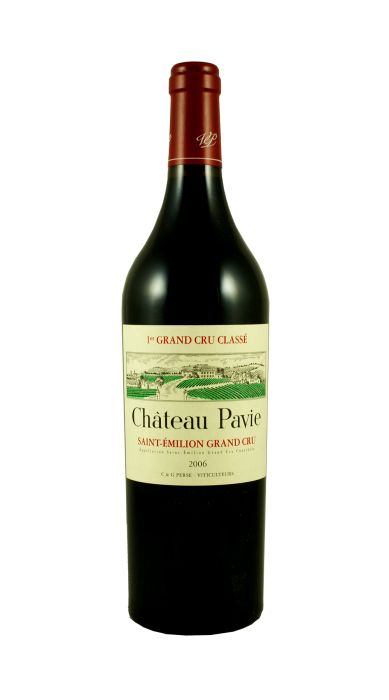
2006 Pavie

96 RP

Availability:

Critic Reviews

This is very tight and juicy with beautiful dark fruit and hints of smoked meat. Full body and soft, racy tannins. Beautiful finish. Love the acidity and minerals here. Focused and polished. Drink now.

James Suckling | 97 JS
Another sleeper of the vintage from Perse, this wine shows lots of licorice, underbrush, blackcurrants and black cherries, cedary wood spice, a round, expansive, full-bodied mouthfeel, beautiful texture and again, stunning purity, all while remaining relatively youthful. This wine probably won’t hit its prime for at least another 4-6 years and is certainly capable of lasting a quarter of a century afterward.

Robert Parker | 95 RP
Saturated bright ruby. The fruit-driven aromas of black raspberry, blueberry, violet pastille, espresso, minerals and sexy oak offer superb perfume. Hugely rich and sweet but with outstanding inner-mouth minerality and energy and enticing violet lift. For all its ripeness, there’s nothing roasted about this superconcentrated Saint-Emilion; in fact, this wine is quite backward and reserved today. The finish features exceptionally sweet tannins and great palate-saturating length. The bottled wine has turned out to be even better than my barrel tastings suggested. Wow!

Vinous Media | 95 VM
Always ripe, always velvety and dense in texture, Pavie’s 2006 nevertheless also shows more structure and elegance than in the past few vintages. The result is a great wine, with smoky, rich fruit and a dense, concentrated core of sweet tannins, chocolate and fresh raspberry flavors. While it is seductive now, it really needs many years of aging.

Wine Enthusiast | 95 WE
Hitting its stride now, with alluring singed juniper and apple wood notes that have melded nicely with the core of lightly steeped red currant and blackberry fruit. A graphite edge runs underneath and the finish pulls everything together, adding a warm tobacco accent.--Non-blind Pavie vertical (March 2017). Drink now through 2030.

Wine Spectator | 94 WS
Great depth of flavour, layers of smooth black fruit emphasising texture over taste, with firm tannins that draw you in while keeping you at arm’s length. This is very young but is significantly more resolved than it was a few years ago. I am always a bigger fan of Pavie in the vintages that force a slightly early picking. Still, when will Pavie truly believe that less is more? Drinking Window 2018 - 2035.

Decanter | 92 DEC
Even in blind tastings, the superconcentrated, modern style of Pavie brings out the partisans. One taster described it as ’a loudly dressed Liberace cuvĂ©e.’ Another praised its dark, floral fruit, depth and minerality. It is a great terroir, and if you appreciate new oak and deep, rich fruit, Pavie is fine and gracious in the 2006 vintage.

Wine & Spirits | 91 W&S

Wine Details for 2006 Pavie

Type of Wine Bordeaux Red : Picture in your mind a combination of cedar, lead pencil, blackcurrant, plum and mineral aromatics, and texture that caresses your palate like a playful lover. The experience is thrilling from the first whiff to the final seconds of a tannic, generous finish - that is what you'll get from a Bordeaux Red
Varietal Proprietary Blend : Proprietary Blend is a general term used to indicate that a wine is comprised of multiple grape varietals which are either “proprietary” to the winery or is blended and does not meet the required maximum or minimum percentage of a particular varietal. This also is the case for the grape’s place of origin, especially for region, appellation or vineyard designated wines. There are endless examples of blended wines which are labeled as “Proprietary Blend” and in conjunction with each region’s stipulated wine laws and regulations makes for a vast blanket for wines to fall into. Perhaps the simplest example is California; if a wine is to be labeled as Napa Valley Cabernet Sauvignon, it is required to have at least 75% of the varietal (Cabernet Sauvignon) and 85% of the fruit must be cultivated from the Napa Valley wine district. If the wine does not meet the requirements, it is then labeled as Proprietary Blend.

Country France : Wine is the lifeblood that courses through the country of France, pulsing with vigorous pride and determination. Viticulture is not just a hobby or an occupation in France; it is a passion, a cherished tradition that has been passed down through generations of wine stained hands. Winemaking is a beloved art that has been ingrained in the culture, an aptitude instilled in sons by fathers and the hallmark for which France’s reputation was built, allowing it to be renowned as, arguably, the most important wine producing country in the world.


For centuries, France has been producing wines of superior quality and in much greater quantity than any other country in the world. It boasts some of the most impressive wine regions, coveted vineyards and prestigious wines on earth. The regions of Bordeaux, Burgundy, Rhone, Sauternes and Champagne have become the benchmark, for which others aspire to become. Legendary producers such as Chateaux Margaux, Domaine De La Romanee Conti, Chapoutier, d’Yquem and Dom Perignon are idolized world-wide.


France has stamped its name on nearly every style of wine, from the nectar-like sweet Sauternes to hedonistic Chateauneuf Du Papes classic Bordeaux and Burgundy, to its sparkling dominance in Champagne. Many of the most infamous grape varietals in the world, such as Cabernet Sauvignon, Merlot, Pinot Noir and Chardonnay originated in France and are not only beloved, but utilized in the creation of some of the greatest wines on earth. French wine production commands the attention of the wine market year after year. With over 860,000 hectares under vine, and numbers close to 50 million hectoliters of wine produced annually, France dominates the market and sets the standard for not only product quality, but also quantity.


France’s many contributions to the world of wine have been absolutely indispensable. The country is the originator of the term “Premier Cru,” coined the term Terroir (a French term so complex there is no literal translation) and has laid the blueprint for a structured appellation system, which others have implemented in their own countries. French vineyard techniques and winemaking practices are mimicked world-wide. California vintners have been replicating Rhone style wines for decades, South America has adopted the French varietal of Malbec and countries around the world are imitating Burgundian styled Chardonnay and Pinot Noir.


With vast diversity in terroir, France is home to some of the most hospitable winegrowing locations on earth. The combination of topography, geology, climate, rainfall and even the amount of sunlight combined with the long historical tradition of winegrowing and making, has allowed the vintners of France to not only hone their skills, but learn from nature to create a product that like the world in which it resides… is very much alive.


Region Bordeaux : Even among the greatest and most reputable wine regions on the planet, Bordeaux stands above the rest. The winemakers of this region have a single-minded dedication to the fine art of viticulture and their efforts never fail to show. If you consider yourself a fine wine enthusiast, you owe it to yourself to visit Bordeaux - life changing. Whether you wish to drink some inspirational and gripping wine as soon as possible, or you want to add some masterpieces to your collection, no region on Earth is a more obvious choice.

The noble and beautiful Garonne and Dordogne rivers surge through southwestern France, enriching the soil in a way very few other places can boast. The limestone-based earth is rich in calcium, and the almost oceanic climate conditions give the staple Bordeaux grape varietals vigor and flavor like nowhere else. For their illustrious reds, Bordeaux winemakers rely on a proven combination of Cabernet Sauvignon, Malbec, Merlot, Cabernet Franc and Petit Verdot. Meanwhile, a sip of their excellent white wine hints at the use of Semillon, Muscadelle and Sauvignon Blanc.Each of these varietals carries a unique identity, making every quality wine a character piece to rival Citizen Kane. It can be incredibly hard to choose only a few wines to collect for your cellar!
Subregion Right Bank
Appellation Saint Emilion

Overview

Producer Chateau Pavie : The slopes of Chateau Pavie were first cultivated during the time of the ancient Romans in the 4th century AD, making this illustrious estate one of the eldest in the world. However, Pavie would not garner attention until almost two thousand years later when the Robert Parker of the day, Cocks et Ferret highly praised the estate. Cocks et Ferret authored Bordeaux et Ses Vins (Wines of Bordeaux) which was considered the “Bordeaux Bible” of that era. This highly regarded publication released in the 1850’s was already high on the wines of Pavie; naming it one of the First Classed Growths in Saint Emilion. Paradoxically, this ancient estate would eventually earn a reputation for its extremely modernist approach to winemaking.

The history of Chateau Pavie is a long and winding road that incorporates Pavie Decesse and Pavie Macquin, as well as some of the most highly regarded winemakers and growers in the history of Bordeaux. In 1885, Ferdinand Bouffard arrived at Chateau Pavie, bringing with him an energetic and determined desire to swell the property holdings. He managed to piece together a 50-hectare parcel with an annual production that ranged from 12,500 to 15,000 cases. Bouffard’s ambitious efforts proved fruitful and Chateau Pavie had become one of the largest estates in the Right Bank.

Very near the 1900s, Bouffard decided to separate the vineyard, creating two entirely separate estates. This was the birth of Chateau Pavie Decesse. Also at this time in the estate’s history, the Macquin family were busy purchasing parcels of vineyards in the appellation. These purchases led to the creation of Chateau Pavie Macquin. At the end of the First World War and beyond, the estate would endure a change of hands, beginning with the sale of the property to Albert Porte, who eventually sold the vineyard to the highly popular Valette family and well-known Bordeaux negociants from Paris.

During the Valette family’s tenure, Chateau Pavie would be classified as Premier Grand Cru Classe B. This popular family was also in possession of the grand Chateau of Troplong Mondot at the time and were recognized as highly driven and accomplished. They would oversee the property, elevating its status among Saint Emilion estates until 1998, when it was purchased by Gerard Perse for a whopping 31 million dollars. He was well-known for his extremely ambitious nature, dedicated efforts in increasing quality and his “spare no expense” attitude. Under the tutelage of Gerard Perse, Chateau Pavie would experience a rebirth, bringing the estate into the modern era.

Perse would hastily begin renovations to the chateau, cellars and extensive replanting of the vineyard to reach the proper level of vine density. Other parcels on the property were re-cultivated (parcels that were not currently being used for cultivation) of which 25% of the vineyard demanded extensive work. He insisted that a lot has changed over the past decade and that his efforts would be exhausted in order to keep up with the times. Determined to increase the size of the vineyard, Perse would acquire 2.5 hectares, when the vines of Chateau La Clusiere were incorporated into Chateau Pavie, an integration that was authorized by INAO, which is the French organization charged with regulating agricultural products with protected designations of origin. Another vineyard increase occurred when a small portion of the Pavie Decesse vineyards were merged into Chateau Pavie, swelling the estate by 6 hectares and decreasing Pavie Decesse from 9.5 hectares to 3.5 hectares.

Today, the 42-hectare estate of Chateau Pavie, 37 hectares of which are under vine are planted to 50% Merlot, 30% Cabernet Franc and 20% Cabernet Sauvignon. The vineyard is one large block, which is almost unique in Saint Emilion but more importantly is the diversity of the terroir, where an array of soils and micro-climates present unique characteristics of each area of the vineyard. The single block vineyard, located on a plateau that reaches an elevation of 110 meters, is divided into 21 separate parcels. The terroir varies between deep, rich clay in the subsoil of the plateau, with sand, clay and gravel soil present near the bottom of the hill. The greatest terroir of the vineyard, perhaps, is located at the peak just behind the chateau where the vines are old, averaging close to 50 years of age. The sloping terrain greatly enhances drainage, allowing the vines to prosper in the rich soil.

Chateau Pavie has an annual production of 8,000 cases. It is recognized as a unique style of Bordeaux wine; rich, filled with minerality and a special purity of fruit that only comes from the world’s best wines. It is a tremendously built wine that should reach its peak maturity between 15-40 years of age after the vintage. The long and winding history of Chateau Pavie has had an incredible path leading towards its now greatly recognized reputation and quality. It is said that Gerard Perse was overcome with emotion when his chateau was awarded Premier Grand Cru Classe A in 2012. This grand estate has risen to the top echelon of not only Saint Emilion, but all of Bordeaux.

People also bought:

Need Help Finding the right wine?

Your personal wine consultant will assist you with buying, managing your collection, investing in wine, entertaining and more.

loader
Loading...