Important Notice

By continuing, you agree to our privacy policy, consent to cookies, and confirm you are 21 or older.

I have read and agree to the Privacy Policy and Terms of Service.

YOU MUST BE 21 OR OLDER TO CONTINUE

NYC, Long Island and The Hamptons Receive Free Delivery on Orders $300+
Cool Wine Shippers Now Available.

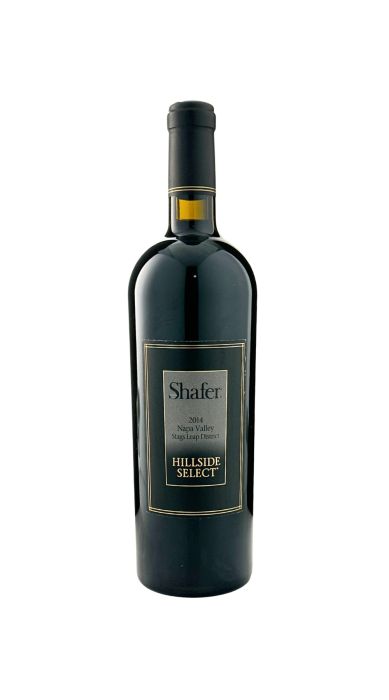
2014 Shafer Cabernet Sauvignon Hillside Select

98+ RP

Availability:

Critic Reviews

Very deep inky-purple colored, the 2014 Cabernet Sauvignon Hillside Select is incredibly intense and impactful on the nose, revealing notes of crushed black cherries, blackberries and fresh black currants with underlying notions of charcoal, sautéed herbs, black soil, chargrilled meat and pencil lead, plus a waft of violets. Very full-bodied, very rich and wonderfully concentrated, the wall of fruit is well matched by a firm structure of ripe, grainy tannins and plenty of freshness, finishing with great length and depth.

Robert Parker Wine Advocate | 98+ RP
The 2014 Cabernet Sauvignon Hillside Select is a classic wine for the era. It is deep, dark and explosive, with serious depth and tons of texture. Black cherry, espresso, licorice, plum, incense and new leather all come together, building toward its huge, resonant finish. At age ten, the 2014 remains quite youthful. Blood orange, cinnamon and leather linger on the potent, driving close.

Vinous Media | 98 VM
Lastly, the flagship 2014 Cabernet Sauvignon Hillside Select is 100% Cabernet Sauvignon (the only vintage where it wasn’t 100% was in 1984, when it included 9% Cabernet Franc) brought up all in high-class French oak. A textbook example of the balanced nature of the 2014 vintage, it offers a complex bouquet of crème de cassis, lead pencil shavings, tobacco leaf, and subtle minerality. Finesse-driven yet powerful on the palate, with full-bodied richness, its tannin structure is perfectly integrated into the wine, it has notable purity and freshness, and a great finish. It’s relatively approachable by this cuvée’s standard but has another 20-30 years of longevity ahead of it.

Jeb Dunnuck | 97 JD
A fascinating nose of licorice, tarte tartin, blackcurrant compote, orange rind, ivy, holly, pine needles, ash, Christmas cake and even raspberry cheesecake as well as a slight minty/herbal note. The palate is so well-knit but powerful; it’s the sort of wine that takes no prisoners. Yet the vintage shines through, and it remains always fresh and balanced. Layers upon layers of fruit and a long, decadent finish. Drink in 2022.

James Suckling | 97 JS
The famous wine lives up to its mighty reputation in this vintage. Densely packed in tones of red currant, cassis and cocoa powder, the palate offers a sublime texture that lingers despite an overall powerful punch of structure and tannin. Elements of crushed rock and black licorice unfold on the finish. Enjoy from 2024–2034.

Wine Enthusiast | 97 WE

Wine Details for 2014 Shafer Cabernet Sauvignon Hillside Select

Type of Wine California Red : Whether it's Cabernet Sauvignon, Merlot, Syrah or Zinfandel, Californian red wine producers have a lovely habit of taking a varietal and expressing its essence in a unique, never before seen way. From Napa Valley to the regions south of Los Angeles, there's a red for everyone - and it's never too late to start exploring.
Varietal Cabernet Sauvignon : It is recognized worldwide, referred to as “king of grapes” and has easily become the most popular grape variety in the world. Cabernet Sauvignon has seemingly taken the world by storm. It has seen exponential growth and popularity in American and around the world over the past thirty years. The phrase “Cabernet is king,” is a common maxim in the world of wine. Cabernet Sauvignon wine has become so popular that when being referred to can be recognized by simple slang, such as “Cab” or “Cabernet. It might appear simple, straightforward and easily understood; yet, interestingly remains an enigma, which has both baffled and excited oenologists since its discovery.

The exact origin and circumstances of this world-altering event are still enigmatic; however, at the end of the 20th century, UC Davis Scientists (John Bowers and Carole Meredith) were able to solve part of the mystery using DNA fingerprinting technology that proved Cabernet Sauvignon to be the offspring of a surprising spontaneous crossing of Bordeaux varietals, Cabernet Franc and Sauvignon Blanc. By the 18th century there were already records of Cabernet Sauvignon being well-established on the west side of the Gironde Estuary (Left Bank) in the Medoc and Graves.

Although tremendously popular in California and what seems to have become the identity of Napa Valley winemaking, Cabernet Sauvignon’s birth took place in the Bordeaux region of southwest France by fortuitous unification. Whereas Napa Valley experienced a winemaking renaissance during the 1970’s and 1980s (greatly due to the 1976 Judgement of Paris) quality wine from the Cabernet Sauvignon grape has been produced in the Medoc, on the Left Bank of Bordeaux for over 400 years.

Cabernet Sauvignon’s first recorded plantings in California can be traced back to the 1850’s when Antoine Delmas, a French nurseryman, brought French vines (including one called ‘Cabrunet’) to the Santa Clara Valley. Early cultivation suffered due to obscurity of the varietal and improper planting in inhospitable soil. It wasn’t until pioneers such as Robert Mondavi, Randy Dunn and Warren Winiarski with their amazing foresight and understanding of terroir, would the grape variety finally find its niche in California winemaking.

Cabernet Sauvignon thrives in warm climates moderated by a cooling marine influence. It is perfectly attuned to gravel-based soils with good drainage. Whether on flat land or a hillside, the Cabernet Sauvignon grape flourishes in proper climates and terroir, producing incredible yields. The thick grapevine is extremely vigorous allowing it to exploit its natural host. Its distinctive small, black berries (reminiscent of blueberries) adhere firmly to the stalk and are capable of a very long “hang time.” These berries are extremely concentrated, producing intensely flavored fruit. The thick skins of the grape are characterized as having highly astringent flavor, high tannin, acidity and dark color. Coincidentally, the variety has a special affinity for oak, which helps soften the bitterness.

Today, the Noble Bordeaux varietal of Cabernet Sauvignon is planted on 340,000 hectares (741,300 acres) of vineyards across the earth’s surface. From Sicily to Sonoma, Chile to Bordeaux, South Africa to Napa. It has found symbiosis in terroir hotspots that mimic that of the Medoc and Napa Valley. Cabernet Sauvignon’s globetrotting has allowed the grape variety to take root all over the world, captivating its inhabitants and influencing winemaking. This serendipitous marriage between Cabernet Franc and Sauvignon Blanc centuries ago, which offered to the world its progeny, has changed the landscape of winegrowing, winemaking and the face of the entire wine market forever. It has influenced blending, changed civilization and has cultivated a place for itself in today’s world… the very pinnacle.

Country US : As one of the most prolific and innovative wine regions in the world, America is a joy to explore. Most wine connoisseurs will agree that the nation's finest and most compelling wines are being produced today, which means that we have front-row seats to one of the most inspirational stories in wine history. While other regions tend to focus on specific wine styles and have somewhat strict rules as to which varietals you could grow, areas like California have few such restrictions in place. As a result, creative visionaries behind America's most reputable estates have been able to develop compelling, unique, and innovative styles, with a level of terroir expression that rivals even France's largest giants.
Region California : With a history of wine production that dates back to the 18th century, California currently sits as one of the world's most prolific and reputable wine regions. With an area as vast as California, you can expect a colorful collage of terroir profiles, a series of microclimates, and micro-environments that give the wine a unique, memorable appeal. The region's produce is far from homogenized in that sense, and it would take you countless hours to sample all of it. While the region boasts scars from the Prohibition era, it went through what can only be described as a viticultural Renaissance sometime after the 1960s. At that point, California went from a port-style, sweet wine region to a versatile and compelling competitor on the world market. Today, no matter which way your taste in wine leans, you can find a new favorite producer among California's most talented.

Notable sub-regions include legendary names like Napa Valley and Sonoma County, places that any wine lover would die to visit. California's quintessential warm climate allows for incredibly ripe fruit expressions, a style that provides a stark contrast to Old World-inspired, earthy classics. Even where inspiration was clearly taken from staple French appellations, Californian winemakers put their own unique spin on the wine.
Subregion Napa Valley
Appellation Stags Leap District
Climat/Vineyard Hillside Select
Cru Estate

Overview

Producer Shafer Vineyards

People also bought:

Need Help Finding the right wine?

Your personal wine consultant will assist you with buying, managing your collection, investing in wine, entertaining and more.

loader
Loading...