Important Notice

By continuing, you agree to our privacy policy, consent to cookies, and confirm you are 21 or older.

I have read and agree to the Privacy Policy and Terms of Service.

YOU MUST BE 21 OR OLDER TO CONTINUE

NYC, Long Island and The Hamptons Receive Free Delivery on Orders $300+
Cool Wine Shippers Now Available.

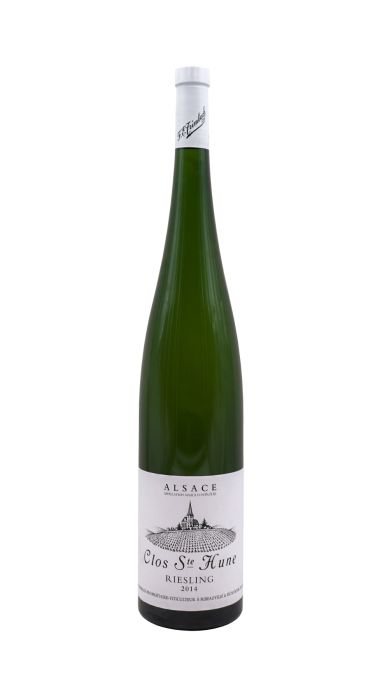
2014 Trimbach Riesling Clos St. Hune

99 JS

Featured Review
A stunning wine with ethereal aromas of sliced apple, sliced pear and mineral character. Flowers and honeysuckle too. Full-bodied, very tight and dense. It goes so deep and beautiful. Bright and tangy acidity. Has the depth of a great vintage of grand cru Burgundy but is so Clos Ste. Hune in character. Muscularly feminine and breathtaking. Available in 2019. James Suckling

James Suckling | 99 JS

Critic Reviews

A stunning wine with ethereal aromas of sliced apple, sliced pear and mineral character. Flowers and honeysuckle too. Full-bodied, very tight and dense. It goes so deep and beautiful. Bright and tangy acidity. Has the depth of a great vintage of grand cru Burgundy but is so Clos Ste. Hune in character. Muscularly feminine and breathtaking. Available in 2019.

James Suckling | 99 JS
The 2014 Riesling Clos Ste Hune is clear and intense on the concentrated nose, offering ripe white-fruit aromas. On the palate, this is a bone-dry, vital and finessed Riesling with a long and tension-filled, salty finish. The 2014 is a kind of quintessence of the Ribeauvillé/Hunawihr terroir: pure, lean, stony and salty, with no flesh, but lots of bones and minerals at this very early moment. Picked at 35 hl/ha this is a straight Sainte Hune that will last for for 30+ years.

Robert Parker Wine Advocate | 96 RP
(Riesling “Clos Ste. Hune”- Maison Trimbach) The 2014 vintage of Clos Ste. Hune is one of the ripest in recent memory, as the wine tips the scales at 14.5 percent octane this year. However, the terroir here handles the ripeness beautifully, so the wine is still its inimitable aromatic constellation of tangerine, apple, lime blossoms, a touch of mintiness, plenty of petrol, a kaleidoscopic base of chalky minerality, delicate white flowers and a topnote of citrus peel. On the palate the wine is deep, full-bodied, focused and bottomless, with a rock solid core, great mineral drive and cut, vibrant acids and lovely balance and grip on the long, ripe and very complex finish. The 1990 Clos Ste. Hune was another ripe vintage out of the blocks, and there are certainly some similarities to be found here in the 2014 version, though this seems perhaps just a tick higher in octane than the ’90. It is approachable today, but still in climbing mode and will be even better with further bottle age. (Drink between 2020-2055).

John Gilman | 94+ JG
Pale straw-green. Very deep, pure aromas of stone fruits, green papaya, licorice and lemon verbena. Rich and dense, but with vivid acidity providing the stone fruit and citrus flavors with remarkable clarity and cut. The extremely long finish features lingering floral and lemon nuances. This strikes me as being just a bit riper than the Frédéric Emile, but with sneaky underlying power and a refined mouthfeel brought out by the calcaire of the Rosacker. The crop level here was reportedly only 35 hectoliters per hectare.

Vinous Media | 94+ VM
This is Pierre Trimbach’s 35th vintage of Clos Sainte Hune, which he now makes with his nephew, Jean. Located within the Rosacker grand cru in Hunawihr, the Clos is the family’s most prized vineyard site, 4.12 acres of vines, the oldest planted in 1951, growing in muschelkalk, a fossil-flecked limestone. Protected by the height of the Vosges mountains and by the stone wall that surrounds the vines and helps trap the warmth of the sun, riesling thrives in this site. The 2014 vintage, from a relatively cool ripening season, has enough acidity and mineral power to catch in the back of your throat, and yet the wine is saturated and elegant, making that tickle a signal to sit up and take notice. What’s remarkable about this riesling is the precision of its flavors and structure, sustained in the midst of its bold intensity. The chalk, lemon pith and white cranberry purity of that flavor is youthfully reticent, delivering hints of what this will become with age.

Wine & Spirits | 94 W&S
Wine Details for 2014 Trimbach Riesling Clos St. Hune

Type of Wine Alsace White : Dry, refreshing, and (typically) infused with the purest form of Riesling; Alsatian whites are loved all over the globe. They will mesmerize your senses and expand your mind through their immense purity, compelling textures, and fluent terroir expression. Get immersed and fall in love with this utterly unique style of wine.
Varietal Riesling : It has been 587 years since the official “birth” of Riesling, the Noble grape variety of Germany. In that time, this white grape has seen exponential growth and popularity worldwide. Riesling has traveled beyond the Rhine River, where it is thought to have originated, spreading throughout Germany, Austria and Alsace, Australia, New Zealand and California. New World adaptations may have helped bring the varietal into the global spotlight, but its ancestral home and greatest reflection of terroir remains in Germany.

As aforementioned, the first recorded mention of the varietal appeared in the 1435 sale of several Riesling vines to German Count, John IV of Katzenelnbogen. Prior this transaction, the history of Riesling remains unclear, other than it first inhabiting the Rhine River region, which runs throughout parts of Germany, France, Austria and Switzerland. In 1998, scientists in Austria, using DNA technology, were able to determine that Riesling is the progeny of Heunisch Weiss, otherwise known as Gouais Blanc. Said to be a commoner among superior grape varietals, Gouais Blanc is ancient, originated in Germany and has sired some of the greatest varietals in the world, including Chardonnay, Semillon, Gamay noir, Melon and Aligote.

The small, round white-green berries of Riesling turn a pretty gold color, often with lenticels (pore-like structures, resembling freckles) when ripe. Vines can vary significantly from weak to moderately vigorous depending on the climatic region, soil characteristics and moisture availability. They are adaptable to a wide range of soil types making it quite dynamic and versatile.

One of Riesling’s most unique and celebrated qualities is its vibrant expression of terroir. This “sense of place” enables the particular elements of the soil and microclimate to be uniquely expressed through the wine itself, allowing this globetrotting varietal to flourish in similar winegrowing conditions around the world. Riesling has found success and popularity in California and the Finger Lakes of New York, Australia, New Zealand, France, Hungary and South Africa. However, it reaches its true zenith in the Rhine River Valley.

Mosel, Pfalz and Rheingau are the key winegrowing locations in Germany, where the climates are cool with low average temperatures and with the bulk of rainfall occurring during the summer. The vines of Riesling thrive here, in heat-retaining, stony soils on steep, south-facing slopes along the river valleys where they find optimal sunlight and natural growing conditions. Austria and Alsace (France) share similar climatic influences and terroir due to the proximity of the Rhine River. Their winegrowing industries have been greatly impacted by the Riesling grape varietal.

The commonly misunderstood Riesling grape varietal produces wines that are quite austere when young, making many wine drinkers wary of them. A fine Riesling almost demands time in the bottle. In good vintages, Riesling can last several decades and rival the finest whites in the world. At a glimpse Riesling may seem simple, but is actually rather complex. Riesling can be harvested early or late, vinified in many ways and can range from dry to very sweet. The five types of Riesling are Kabinett (bone dry to off-dry) Spatlese (sweet) Auslese (sweeter) Beerenauslese (very sweet) Trockenbeerenauslese (sweetest). Thanks to its naturally high acidity, it is a supremely agreeable drinker that will please just about any palate. From tingly-dry, steely-lemon to refreshingly green apple, peach, pear and grapefruit to honeyed and luscious apricot; the myriad of flavor profiles of Riesling is impressive.

The Noble Riesling grape may be complex, might be misunderstood and may be more obscure than other white varietals, but is one that produces some of the most fascinating, multifaceted and unique wines in the world.

Country France : Wine is the lifeblood that courses through the country of France, pulsing with vigorous pride and determination. Viticulture is not just a hobby or an occupation in France; it is a passion, a cherished tradition that has been passed down through generations of wine stained hands. Winemaking is a beloved art that has been ingrained in the culture, an aptitude instilled in sons by fathers and the hallmark for which France’s reputation was built, allowing it to be renowned as, arguably, the most important wine producing country in the world.


For centuries, France has been producing wines of superior quality and in much greater quantity than any other country in the world. It boasts some of the most impressive wine regions, coveted vineyards and prestigious wines on earth. The regions of Bordeaux, Burgundy, Rhone, Sauternes and Champagne have become the benchmark, for which others aspire to become. Legendary producers such as Chateaux Margaux, Domaine De La Romanee Conti, Chapoutier, d’Yquem and Dom Perignon are idolized world-wide.


France has stamped its name on nearly every style of wine, from the nectar-like sweet Sauternes to hedonistic Chateauneuf Du Papes classic Bordeaux and Burgundy, to its sparkling dominance in Champagne. Many of the most infamous grape varietals in the world, such as Cabernet Sauvignon, Merlot, Pinot Noir and Chardonnay originated in France and are not only beloved, but utilized in the creation of some of the greatest wines on earth. French wine production commands the attention of the wine market year after year. With over 860,000 hectares under vine, and numbers close to 50 million hectoliters of wine produced annually, France dominates the market and sets the standard for not only product quality, but also quantity.


France’s many contributions to the world of wine have been absolutely indispensable. The country is the originator of the term “Premier Cru,” coined the term Terroir (a French term so complex there is no literal translation) and has laid the blueprint for a structured appellation system, which others have implemented in their own countries. French vineyard techniques and winemaking practices are mimicked world-wide. California vintners have been replicating Rhone style wines for decades, South America has adopted the French varietal of Malbec and countries around the world are imitating Burgundian styled Chardonnay and Pinot Noir.


With vast diversity in terroir, France is home to some of the most hospitable winegrowing locations on earth. The combination of topography, geology, climate, rainfall and even the amount of sunlight combined with the long historical tradition of winegrowing and making, has allowed the vintners of France to not only hone their skills, but learn from nature to create a product that like the world in which it resides… is very much alive.


Region Alsace : This region's specific position between France and Germany has made it into a peculiar combination between them in many ways, including its mixed culture of eating and drinking. Elements of both countries can be found embroidered deep into the soul of this special place that shares their traits but doesn't entirely belong to either. When it comes to wine, a wonderful example is the use of a typically German grape Riesling, but in a very much altered style compared to the sweet wines one would normally associate with the name. The wines made here are rich, fruity, relying on lovely spikes of acidity and great texture to deliver complexity and depth without the use of oak. The sweet, elusive aromatics of peach and potpourri provide a wonderful contrast to the dryness of these famous whites, known for their superb balance and graceful poise.

There is so much spirit to Alsace's wines that one could spend months, even years drinking the same vintage and still find new levels of delicious aromas unfolding, never out of ways to enchant and always luring in, like a siren's song. Alsace offers mainly still white wines, sparkling Cremant d'Alsace, occasionally Pinot Noir-based roses and rarely reds.

Overview

Producer Trimbach

People also bought:

Need Help Finding the right wine?

Your personal wine consultant will assist you with buying, managing your collection, investing in wine, entertaining and more.

loader
Loading...