Important Notice

By continuing, you agree to our privacy policy, consent to cookies, and confirm you are 21 or older.

I have read and agree to the Privacy Policy and Terms of Service.

YOU MUST BE 21 OR OLDER TO CONTINUE

NYC, Long Island and The Hamptons Receive Free Delivery on Orders $300+
Cool Wine Shippers Now Available.

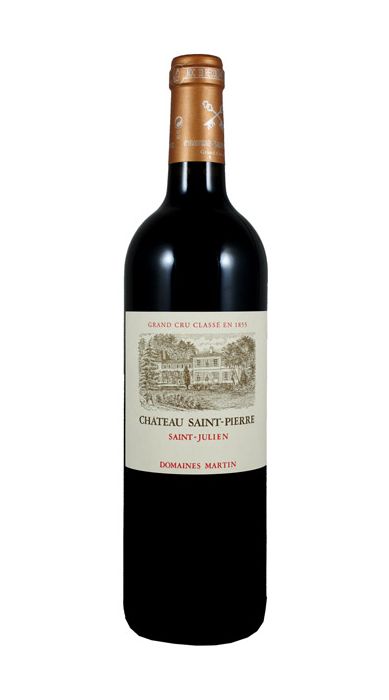
2017 Saint Pierre

95 DEC

Featured Review
(Château Saint-Pierre, St-Julien, Bordeaux, France, Red) Cloves, black pepper, damson, oak swirl and vanilla bean, definitely a more complex and confident nose than many - and the profusion of aromatics adds layers to the wine but doesn't overpower. As the wine opens in the glass, you get attractive raspberry and cassis notes, and an uplift or crushed mint freshness held together with fine tannins. Far from a blockbuster year in St-Julien but this is one of the best; impressive En Primeur and moving up a notch at this point. (Drink between 2024-2045) Decanter

Decanter | 95 DEC

Critic Reviews

(Château Saint-Pierre, St-Julien, Bordeaux, France, Red) Cloves, black pepper, damson, oak swirl and vanilla bean, definitely a more complex and confident nose than many - and the profusion of aromatics adds layers to the wine but doesn't overpower. As the wine opens in the glass, you get attractive raspberry and cassis notes, and an uplift or crushed mint freshness held together with fine tannins. Far from a blockbuster year in St-Julien but this is one of the best; impressive En Primeur and moving up a notch at this point. (Drink between 2024-2045)

Decanter | 95 DEC
Medium to deep garnet-purple in color, the 2017 Saint-Pierre offers up warm cassis, redcurrant jelly, baked black berries and Black Forest cake with earth, herbs and meaty hints. Medium-bodied, it has a great core of muscular fruit with a firm and grainy frame and is solidly built, finishing long and layered. The blend is 73% Cabernet Sauvignon, 20% Merlot and 7% Cabernet Franc, and it was aged in French oak for 14 months, 50% new. About 50% of the total production went into this grand vin, with 80,500 bottles produced.

Robert Parker Wine Advocate | 95 RP
From an estate owned by the same family as Chateau Gloria, the inky hued 2017 Chateau Saint-Pierre (Saint-Julien) is a big, full-bodied, impressive 2017 that has subtle oak as well as lots of cassis, white flowers, burning embers, and charcoal aromas. I love its texture, it has ripe tannins, and it’s just a balanced, complete Saint-Julien that will evolve for 20-25 years. This cuvee is 73% Cabernet Sauvignon, 20% Merlot, and the rest Cabernet Franc, aged in 50% new oak.

Jeb Dunnuck | 94 JD
Warm and seductive in feel, with a cashmere texture to the range of steeped plum, blackberry and black currant fruit flavors. A well-buried alder note runs underneath, while flashes of tobacco and incense swirl around. The smoldering finish is long and rich in detail. Cabernet Sauvignon, Merlot and Cabernet Franc. Best from 2022 through 2038. 6,708 cases made.

Wine Spectator | 94 WS
Such fresh red plums and mulberries here. This really has some alluring fruit and dark, stony nuances. The palate is silky and richly flavored with dark plums and berries. Long, ribbon-like tannins. Drink or hold.

James Suckling | 93 JS
The 2017 Saint-Pierre was cropped 47hl/ha and matured in 50% new oak. It has a very intense bouquet with black cherries, blueberry and violet aromas, quite Margaux like in style. This is floral and inviting, wonderful delineation and focus. The palate is medium-bodied with supple tannins, a fine bead of acidity and harmony, building nicely with a plush and caressing finish. What a superb Saint-Pierre that will give 20+ years of drinking pleasure.

Vinous Media | 93 VM
Wine Details for 2017 Saint Pierre

Type of Wine Bordeaux Red : Picture in your mind a combination of cedar, lead pencil, blackcurrant, plum and mineral aromatics, and texture that caresses your palate like a playful lover. The experience is thrilling from the first whiff to the final seconds of a tannic, generous finish - that is what you'll get from a Bordeaux Red
Varietal Red Bordeaux Blend : The inhabitants of the Bordeaux region of France have been cultivating wine-grapes for thousands of years. Ancient Roman ruins litter the vineyards from Saint Emilion to Graves where the art of blending Bordeaux varietals has been practiced and perfected over a very long history. Bordeaux’s climate, terroir and soils, though varied, provide the optimal growing conditions for the red grape varietals planted in the region.

Rarely listed on the labels as “blend,” the red wines of Bordeaux are perhaps the most artfully designed and celebrated in the world. The calculated art of blending the native Bordeaux varietals is impressively accomplished in the most famous winegrowing region in the world. The phrase Bordeaux Blend which seems to have been coined by British wine merchants in the 19th Century relates as much to wines made from the blend as to the grape variety combination itself.

Cabernet Sauvignon, Merlot, Cabernet Franc, Petit Verdot, Malbec and occasionally Carmenere are the lead characters in the creation of Red Bordeaux Blends. Each plays a part in their own fashion and implemented in various combinations and percentages in each appellation within Bordeaux. Red Bordeaux Blends are majorly composed of Cabernet Sauvignon and Merlot, roughly making up 90% of all Bordeaux Blends. Cabernet Franc, Petit Verdot and Malbec (occasionally Carmenere) are also important components and vital to the production of the region’s red wines.

For simplicity, the winegrowing region of Bordeaux can be divided into three main appellations producing Red Bordeaux Blends; the Left Bank (Medoc), Right Bank and Pessac-Leognan (Graves). The Left Bank has a terroir comprised of a wide variety of gravel, stones, sand, limestone and clay soils on a natural terrain of gentle slopes. This sets the stage perfectly for the production of Cabernet Sauvignon, which is the dominant grape of the Left Bank. For example, Chateau Lafite (Paulliac) is composed of 70% Cabernet Sauvignon.

The Right Bank is dominated by clay and limestone with sand and gravel, but the clay in the Right Bank is distinctly its own and adds to the health, growth and vitality of the vines of the varietals grown here. Right Bank wines are typically 80% Merlot-based, which are often denser, richer and mature earlier than those of the Left Bank (with exceptions – Petrus for example). Merlot is a vital component to Pomerol winegrowing and making. Cabernet Franc also plays a major role in the Right Bank, most notably, in Saint Emilion, where the infamous vineyards of Chateau Ausone and Chateau Cheval Blanc are planted to 55% and 52% Cabernet Franc, respectively. Chateaux that produce wines with a majority of Cabernet Franc are considered “old school” producers, but have perfected the use of Cabernet Franc, which was originally used as a blending grape.

Pessac-Leognan (Graves) enjoys a temperate climate, natural hygrometry influenced by the ocean, and has a terroir composed of gravelly soil over a clay subsoil on sloping, hilly terrain. Natural drainage due to the hilly terrain as well as the gravelly soil structure are perfectly attuned to the Cabernet Sauvignon grape vine, which prospers under these conditions. Pessac reaps the benefits of having the terroir of both the Left and Right Bank as it contains gravel and clay. The clay sub-soil allows the growth and success of Merlot, as well as Cabernet Franc. It is home to the only First Growth not in the Medoc. The 50-hectare vineyard of Haut Brion is planted to 45.4% Merlot, 43.9% Cabernet Sauvignon, 9.7% Cabernet Franc and 1% Petit Verdot.

The percentage of Petit Verdot and Malbec may be lesser in quantity, but not in quality. They are vital to the region’s creation of Red Bordeaux Blends. The combination of Bordeaux varietals is legendary in the region, around the world and has influenced winegrowers worldwide to plant and vinify wines which resemble those of Red Bordeaux Blends.

Country France : Wine is the lifeblood that courses through the country of France, pulsing with vigorous pride and determination. Viticulture is not just a hobby or an occupation in France; it is a passion, a cherished tradition that has been passed down through generations of wine stained hands. Winemaking is a beloved art that has been ingrained in the culture, an aptitude instilled in sons by fathers and the hallmark for which France’s reputation was built, allowing it to be renowned as, arguably, the most important wine producing country in the world.


For centuries, France has been producing wines of superior quality and in much greater quantity than any other country in the world. It boasts some of the most impressive wine regions, coveted vineyards and prestigious wines on earth. The regions of Bordeaux, Burgundy, Rhone, Sauternes and Champagne have become the benchmark, for which others aspire to become. Legendary producers such as Chateaux Margaux, Domaine De La Romanee Conti, Chapoutier, d’Yquem and Dom Perignon are idolized world-wide.


France has stamped its name on nearly every style of wine, from the nectar-like sweet Sauternes to hedonistic Chateauneuf Du Papes classic Bordeaux and Burgundy, to its sparkling dominance in Champagne. Many of the most infamous grape varietals in the world, such as Cabernet Sauvignon, Merlot, Pinot Noir and Chardonnay originated in France and are not only beloved, but utilized in the creation of some of the greatest wines on earth. French wine production commands the attention of the wine market year after year. With over 860,000 hectares under vine, and numbers close to 50 million hectoliters of wine produced annually, France dominates the market and sets the standard for not only product quality, but also quantity.


France’s many contributions to the world of wine have been absolutely indispensable. The country is the originator of the term “Premier Cru,” coined the term Terroir (a French term so complex there is no literal translation) and has laid the blueprint for a structured appellation system, which others have implemented in their own countries. French vineyard techniques and winemaking practices are mimicked world-wide. California vintners have been replicating Rhone style wines for decades, South America has adopted the French varietal of Malbec and countries around the world are imitating Burgundian styled Chardonnay and Pinot Noir.


With vast diversity in terroir, France is home to some of the most hospitable winegrowing locations on earth. The combination of topography, geology, climate, rainfall and even the amount of sunlight combined with the long historical tradition of winegrowing and making, has allowed the vintners of France to not only hone their skills, but learn from nature to create a product that like the world in which it resides… is very much alive.


Overview

Producer Chateau Saint Pierre

People also bought:

Need Help Finding the right wine?

Your personal wine consultant will assist you with buying, managing your collection, investing in wine, entertaining and more.

loader
Loading...