Important Notice

By continuing, you agree to our privacy policy, consent to cookies, and confirm you are 21 or older.

I have read and agree to the Privacy Policy and Terms of Service.

YOU MUST BE 21 OR OLDER TO CONTINUE

NYC, Long Island and The Hamptons Receive Free Delivery on Orders $300+

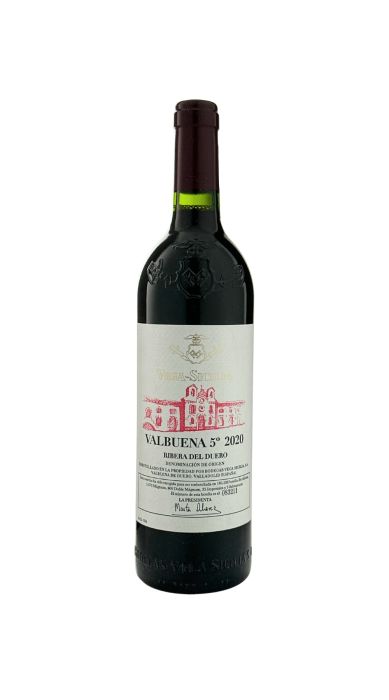
2020 Vega Sicilia Valbuena 5

97 JD

Availability:

Critic Reviews

The 2020 Valbuena 5° ages five years in oak and bottle, which gives it its name. Harvest was challenging due to Covid and rain, requiring due diligence in the field and a faster, earlier harvest than anticipated, the grapes coming from the Vega Sicilia estate’s vines with about 35 years of age. It’s an ethereal, medium-bodied wine of lovely delicacy and elegance, 97% Tempranillo blended with 3% Merlot, then aged 12 months in French and American oak, six months in stainless steel and then 18 months in bottle. Blackcurrant, cedar, and balsamic highlight a citrusy freshness. It will hit its prime in five years and age another 20-25.

Jeb Dunnuck | 97 JD
Produced with a selection form the more ethereal parcels that don’t deliver the power sought for Unico, Valbuena 5Âş is however much more than a younger sibling of the iconic wine. The 2020 vintage, a child of a challenging growing season, both due to natural and operational challenges (remember Covid?...), it is a great achievement of nuanced power and detailed complexity, with a luscious fruit core lined with oregano, dried sage and thyme. Dark chocolate and roasted coffee beans build a broody background layer while Assam and Oolong tea leaves add umami depth. Beautiful detail and depth to the tannins.

Decanter Magazine | 96 DEC
Valbuena 5 used to be the baby Unico, and nowadays it is more like its younger brother with a lot of resemblance and just a bit less depth and tannins. Valbuena 5 comes from younger vines and sometimes different parcels from Unico. On the palate, this is more open and linear, while Unico is more profound and vertical. Notes of iron, blackberries, cedar, minerals and cocoa powder. Medium- to full-bodied with melted tannins and a long, long finish. Drinkable from 2025, but will hold for years.

James Suckling | 96 JS
The 2020 Valbuena is from a year marked by COVID-19 and lots of rain before the harvest, which resulted in a more ethereal wine, with 14% alcohol, a pH of 3.9 and 4.45 grams of acidity. It was produced with 97% Tinto Fino and 3% Merlot, cooled down for 24 hours and then fermented with indigenous yeasts from a pied de cuve in stainless steel. It matured in barrel and oak vats during the first year, and in the second one, it aged exclusively in oak vats of different sizes, 8,500 and 21,000 liters. In 2020, the wine is finer-boned, more fluid and only medium-bodied, perhaps because of the dilution from the rain; the tannins are fine-grained and polished, but there’s less juiciness in the wine. It calls for food. With time in the glass, the wine opens up and becomes more aromatic, and it even seems to gain juiciness and change texture. This is a production of 186,286 bottles, 5,673 magnums and some larger formats. It was bottled in May 2023.

Robert Parker Wine Advocate | 95 RP
The 2020 Valbuena 5Âş is Tinta del PaĂ­s from Ribera del Duero. Balsamic and herbal aromas mingle with forest, red fruit, cherry, violet and a hint of apple peel on the nose. The palate is intense, with a velvety texture, moderate concentration and enveloping flow. Chalky tannins and a touch of creaminess define the structure. Ample and richly flavored, with subtle oak in the background. A fine example of elegant Ribera.

Vinous Media | 95 VM
A harmonious red, fresh and medium- to full-bodied, with a lovely skein of ground espresso, anise and paprika aromas lacing the black plum, cassis, violet, vanilla and loamy earth notes. Its fine-grained tannins are well-integrated and emerge to firm the long, focused finish. Tinto Fino and Merlot. Drink now through 2035. 15,525 cases made, 812 cases imported.

Wine Spectator | 93 WS

Wine Details for 2020 Vega Sicilia Valbuena 5

Type of Wine Spain Red : Spanish wines shouldn't be overlooked under any circumstances, as there are plenty of extraordinary wines coming from this country. There are also lots of grape varietals grown all over Spain. Some of the most gorgeous red varieties are the early-harvested Tempranillo, raspberry-flavored Garnacha, Bobal, Monastrell, as well as Cabernet Sauvignon, Syrah, and Merlot.
Varietal Tempranillo : The world’s most popular and widely planted grape varietals often have a strong presence in their place of origin, where the terroir and climate are most suitable for growth and success. None may be more evident than that of Tempranillo. This Noble Grape is the 3rd most widely planted varietal in the world but is important to note that of the 236,000 hectares planted around the world, 202,000 are cultivated in Spain.

Tempranillo is an ancient grape but very little is known of its history prior to the 19th century. While the earliest mention of Tempranillo is from 1807, there are various speculations of its true time and place of origin. Some believe the grape originated in southern France as a natural hybrid of Cabernet Franc and Pinot Noir. Others believe that Tempranillo was introduced to the Iberian Peninsula by the Phoenicians over 3,000 years ago. According to research conducted at UC Davis, Tempranillo likely originated in Northern Spain, possibly in the winegrowing regions of Rioja and Navarra, where it remains the primary grape variety.

Tempranillo grapes hang in medium to large cylindrical clusters with sparse foliage which needs attention to adapting canopy needs in hotter regions. The pear-shaped, deep blue-black berries of Tempranillo arrive early to the vineyard, usually being harvested in late August to mid-September. The name Tempranillo quite possibly derived from temprano, which means early in Spanish and might be due to the grape’s early ripening.

The varietal thrives in Mediterranean and Continental climates where the days are warm and dry and balanced by cool nights which help to ensure ample fruit and bright structure. Tempranillo easily adapts to the terroir of Spain and greatly prospers in Rioja, La Mancha and Ribera del Duero, where the terroir is composed of a myriad of differing soils and elements, including calcareous and ferrous deposits, clay, sand and alluvial materials. The vines willing set root in free draining gravelly-loam, sand and clay. Tempranillo showcases the terroir though the wine itself, displaying different characteristics which are dependent on location. Rioja and Navarra deliver pepper, red cherry and subtle cinnamon notes with ample structure. Ribera del Duero, Toro and Cigales are typically deeper, darker and more brooding with blackberry fruit flavors and intense tannins. The varietal’s ability to adapt to its elements is as immensely impressive as it is important to Spain’s winegrowing and winemaking industry.

Words often found on Spanish labels include: Roble, Tinto, Crianza, Reserva, and Gran Reserva. These aging terms inform whether the wine has spent little to no time in oak all the way up to 18-24 months with an additional four years of bottle aging. According to many proprietors, the more time spent in oak and aging, the better the quality. This is common practice in Rioja, Duero and La Mancha, where Tempranillo is the workhorse and also the shining star. Wines produced from the Tempranillo grape varietal range from rock star producers in Rioja (Benjamin Romeo Contador) to Ribera del Duero (Vega Sicilia) to quality value wines form La Mancha.

Today, Tempranillo is cultivated in fifteen different countries around the world, including Mexico, South America (most notably Argentina) California and of course, Portugal. Tempranillo is one of the top varietals blended into Port wine from Portugal, where it is called Tinta Roriz. Full-bodied single-varietal examples are starting to gain traction in Dao and Alentejo where the grape is labeled as Aragonez.
Country Spain : Grapevines have been cultivated on the Iberian Peninsula for thousands of years, making Spain one of the oldest wine producing countries on earth. With nearly 1 million hectares under vine, Spain is in possession of more grapevines that any other nation in the world. Today, vineyard cultivation takes place in virtually every administrative district, making it a leading producer on today’s market. Spain’s vineyards generate an annual wine output of 40.7 million hectoliters, ranking it third in the world behind only France and Italy.

Spain is a land of breathtaking beauty, diverse topography, complex cultures and a time honored tradition of viticulture. The country’s broad geographical values play a major role in defining the many wine styles produced. From the cool climes of Galicia and the snow-capped Pyrenees to arid Andalucía in the south, and every region in between the Atlantic and Mediterranean coasts, Spain boasts one of the most diverse terroirs in the world.

The country’s myriad of soils and complex climate systems creates an expansive planting ground for a multitude of varietals. Tempranillo has long played an instrumental role in Spanish winemaking. It is important to note that of the 236,000 hectares being cultivated world-wide, 202,000 are planted in Spain. It is commonly utilized in the production of still red wines from Rioja, Ribera del Duero and Toro and has taken the world by storm. In the past few decades, wines produced in Rioja have been some of the most popular, and in 2017, wines with a “Rioja” label were the most purchased on the wine market. Bodegas Vega Sicilia, located in Ribera del Duero in northern Spain has been one of the most sought after producers hailing from Spain, and Tinta de Toro (otherwise known as Tempranillo everywhere else) has certainly placed its mark on the region and the world.

Spain is also renowned for its production of sweet, raisened Moscatel, fortified Madeira, sparkling Cava and its rising, but shining star, Albarino, which hails from the Rias Baixas appellation of Galicia. Some of the most recognizable names in the world of wine hail from Spain.

In the past few decades there has been a collision of New and Old World winemaking; one which has greatly contributed to the continued success of the Spanish wine industry. Modernization of vineyards, facilities and viticulture has greatly improved the significance of Spain in the wine market. Syrah and Merlot have taken root in Spanish wine regions and combined with the indigenous Garnacha (Grenache) Garnacha Blanca (Grenache Blanc), Godello and many others, the country has not only adapted to new styles of winemaking but also the ever changing palate of consumers.


Region Castilla Y
Subregion Ribera del Duero

Overview

Producer Vega Sicilia

People also bought:

Need Help Finding the right wine?

Your personal wine consultant will assist you with buying, managing your collection, investing in wine, entertaining and more.

loader
Loading...