Important Notice

By continuing, you agree to our privacy policy, consent to cookies, and confirm you are 21 or older.

I have read and agree to the Privacy Policy and Terms of Service.

YOU MUST BE 21 OR OLDER TO CONTINUE

NYC, Long Island and The Hamptons Receive Free Delivery on Orders $300+
Cool Wine Shippers Now Available.

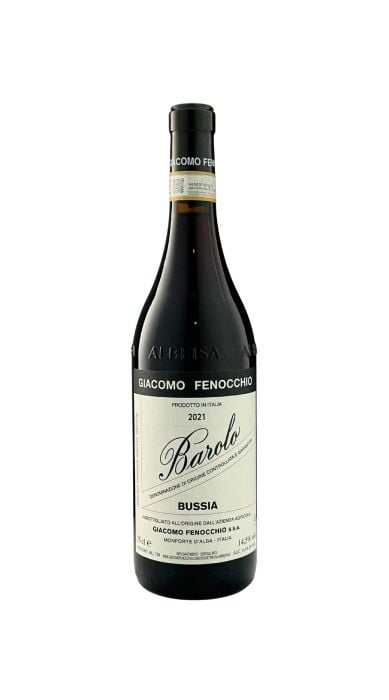
2021 Giacomo Fenocchio Barolo Bussia

98 KO

Availability:

Critic Reviews

The Giacomo Fenocchio 2021 Bussia mesmerizes with its aromas of violet, botanical herb, forest berry, menthol and cake spice. Full-bodied and firmly structured, the utterly delicious palate boasts a great depth of flavors including juicy red cherry, raspberry preserve, cinnamon stick, crushed mint and star anise before a graphite finish, all set against a backbone of fine-grained tannins. Showing serious aging potential, it has bright acidity that also keeps it well balanced. Drink 2033–2051. Abv: 14.5%

Kerin O’Keefe
| 98 KO
From one of Barolo’s most revered sites comes a wine of quiet confidence. The limestone rich soils of Bussia create something profound in 2021. Fresh roses and dark cherries float up, then wild strawberries, fresh tobacco, and mountain herbs fill every corner. The structure feels perfectly calibrated, firm yet graceful. This is Barolo finding its future while honoring its past. A wine that makes you lean in closer with each sip. Drink from 2027

Wine Enthusiast | 98 WE
The 2021 Barolo Bussia is an absolute delight. Aromatic, graceful and light on its feet, the 2021 is pure seduction. Pine, mint, cloves, new leather, licorice, wild cherry and sage are some of the many notes that are laced together in this exquisite, haunting Barolo from Claudio Fenocchio.

Vinous Media | 94 VM
Cherry, plum, orange peel, tomato leaf and eucalyptus notes strike a nice balance with the succulent texture and fine-grained tannins in this lean, savory red. Iron and tar accents emerge as this winds down on the mouthwatering finish. Best from 2030 through 2050. 2,100 cases made, 300 cases imported.

Wine Spectator | 94 WS
Moving to the 2021 Barolo Bussia, it pours a bright transparent red color and offers a pure aromatic profile with notes of cherry candies, preserved orange, amaro-like sweet herbs, and dried earth. The palate is also vibrant and transparent, with a bit more savory iron-richness lurking gently underneath on the finish, framing the otherwise more transparent ripe berried fruit that coaxes through the palate. It has ripe tannins and a bit more richness of texture on the finish that I anticipate will improve over the coming 10-15 years. Drink 2026-2038.

Jeb Dunnuck | 94 JD
Located in the heart of Bussia, the Giacomo Fenocchio estate counts 5ha in the Sottana subzone. As with all the MGA bottlings, fermentation is spontaneous with indigenous yeasts, maceration is upwards of 40 days, and ageing is in large Slavonian oak casks. The 2021 has a flamboyant side, leading with roasted coffee, iron, grilled bay leaf and crushed allspice aromas. As animated as the nose is, the palate needs a bit more time to come together, however it is well packed with dense dark cherry and perfumed fennel. The tannins are chalky yet sweet, with a taut snap. I love the saline twist on the finish.

Decanter Magazine | 94 DEC
Blackberries with sweet spices, as well as plums and a touch of cedar. The palate is medium- to full-bodied with polished yet firm tannins that stick to the palate. Lovely, juicy fruit profile. This should evolve nicely, but needs some time. Better from 2026.

James Suckling | 94 JS
Wine Details for 2021 Giacomo Fenocchio Barolo Bussia

Type of Wine Italy Red
Varietal Nebbiolo : Nebbiolo is the superstar grape variety and driving force behind the top-quality red wines of northwestern Italy. The Italian winegrowing appellation of Piedmont is covered by a sea of Nebbiolo grape vines. It is the undisputed king of grapes in the twin hillside villages of Barolo and Barbaresco, where some of the world’s most coveted wines hail from.

Quality over quantity is the motto for this subtly powerful grape. A mere 5,500 hectares of Nebbiolo are cultivated around the world, of which, more than 4,000 are found in Langhe and Roero. The varietal has been growing here since the 1st century and has been called Nebbiolo since the 1200’s. Like most ancient grape varietals, there are many speculations as to its true origin, but what is certain is that in the hills of Langhe and Roero, Nebbiolo has found its ideal environment.

Unlike Cabernet Sauvignon which is a versatile grape, Nebbiolo has not thrived when planted in wine regions outside of northern Italy. Nebbiolo is more like the finicky Pinot Noir: difficult to grow and highly reflective of terroir. The varietal thrives on calcareous marl, a lime-rich mudstone that is found on the right back of the Tanaro River (home to Barolo and Barbaresco) where it grows best in its warm climate and ample sunlight. The growing conditions in the hilly areas of Barolo and Barbaresco are optimal and produce some of the most sought after wines not only in Italy, but in the world.

The Nebbiolo vine buds earlier than most grapes grown in Piedmont but harvested last. The berries do not appear until long after flowering, making it very susceptible to poor weather conditions. The name Nebbiolo is thought to have come from the Italian word for fog, nebbia, which is common during the fall when the local hillsides are covered in a ghostly haze.

The iron fist in a velvet glove, which is a witty slogan for the wine of Barolo, can aptly be used to define the Nebbiolo grape itself. The thin-skinned, light colored grape packs a punch, producing wines that are light ruby when young and fades to a pale garnet when older. This characteristic should not be mistaken as watery; wine produced from Nebbiolo is super concentrated and flavorful with high acidity and tannins. When properly vinified, the best vintages will last for decades.

Despite the challenges of this fussy grape, some growers in the “New World” are trying their hand at harvesting Nebbiolo. In South Australia young producers are making wines that are fruiter and less tannic than their Italian counterparts. This novel take on the Italian grape has prompted California, Chile and South Africa to begin small plantings of Nebbiolo.

The iron fist in a velvet glove, the undisputed king of Piedmont and the deceptively powerful Nebbiolo grape may be limited in quantity, much-coveted, nearly exclusive to Italy, demands aging and can sometimes command high prices; the wait, the price and the difficulty in finding it is rewarded with one of the greatest wines made from the mighty Nebbiolo grape varietal.

Country Italy : Italy is renowned as one of the world’s greatest gastronomic havens; from certified Prosciutto di Parma to the sea-side seafood eateries on the island of Sicily. However, this epicurean experience could not possibly be as hedonistic without the ethereal combination of the country’s plethora of fine wines. It seems unfair that a nation should be able to boast, both, some of the world’s greatest cuisine as well as its greatest wines. Italian wine is one of the most sought after in the world, and has become the second most produced in the world, behind only France.


Stretching an impressive 736 miles from northern Italy to the peninsula’s southern tip, the country’s geography generates an enormous array of topography, climate and soil structure. This is an extremely important quality of its winegrowing and making industry which lays claim to nearly 550 different grape varietals, which all desire their own necessities, in terms of terroir and climate.


The still red wines of Italy truly characterize the nation’s vast and expansive terroir; Nebbiolo dominates Piedmont, where Barolo and Barbaresco reign king and queen of the region’s production. Hailing from Brunello di Montalcino in Tuscany, the rockstar Sangiovese grape has become synonymous with greatness. Vin Santo sweet wines have taken on a mighty feat of competing with the glorious wines of Sauternes, and of course, Prosecco. Prosecco, located in Trieste (northeast Italy) and its creation of luxuriously effervescent styles of wine has become Italy’s answer to Champagne. The Glera grape variety, which has become synonymous with the name Prosecco, is the main ingredient and is beloved in the appellation where the village of Prosecco’s name has become world renowned.


The blurred boundary between Italy and the countries of Slovenia and Austria, where German influence still resonates through Friuli wines. The prevalence of Riesling and other such grape varietals is high in this region and have become extremely popular on today’s market.


With nearly 702,000 hectares of grapevines covering the massive and diverse landscape, Italy’s annual average of 48.3 million hectoliters of wine production is second only to France in terms of volume and Spain in terms of hectares of vines. The country is vast and overwhelming when it comes to the culinary arts, but perhaps even this is overshadowed by its production of some of the world’s most sought after wines, whether the omnipresent Chianti to the highly collectible and sought after Amarone della Valpolicalla.


Region Piedmont : Italian culture values the unbreakable bond we share with family and very few things showcase that connection quite like a shared meal. Therefore, it's only natural that wine would also take its place as an important cultural aspect. Fine Italian produce always goes well with a variety of dishes, and that makes these wines an incredibly popular choice among wine enthusiasts who appreciate a good get-together. The foothills of the Alps help define this region's significantly colder, continental winter climate, but during the summer, the conditions are similar to the region of Burgundy.

Flavor-wise, this region has a mind-boggling variety to offer. Not only is there a healthy selection of approved grapes to work with, but the soil often varies from estate to estate, letting every wine stand out. Expect to encounter powerful notes of rose petal flavor, spices, cherries, dried herbs, anise, and many more. Every bottle has a story to tell. Those of you with a tendency to hoard and collect fine wines will be especially intrigued, as Piedmont wines tend to mature extremely well, developing nuance and becoming more and more delicious as time goes on.

Subregion Langhe
Appellation Barolo
Climat/Vineyard Bussia

Overview

Producer Giacomo Fenocchio

People also bought:

Need Help Finding the right wine?

Your personal wine consultant will assist you with buying, managing your collection, investing in wine, entertaining and more.

loader
Loading...