Important Notice

By continuing, you agree to our privacy policy, consent to cookies, and confirm you are 21 or older.

I have read and agree to the Privacy Policy and Terms of Service.

YOU MUST BE 21 OR OLDER TO CONTINUE

NYC, Long Island and The Hamptons Receive Free Delivery on Orders $300+

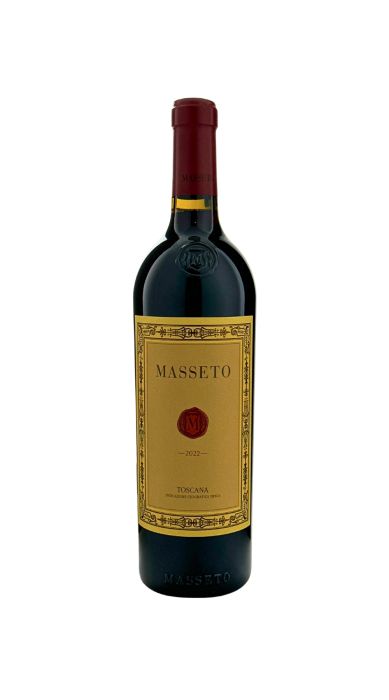
2022 Masseto

98+ JD

Availability:

Critic Reviews

This vintage of the 2022 Masseto is 100% Merlot. The nose is pronounced, leading with its mineral aromas of crushed dark stones. It smells like dissolved minerals, delicate peppery accents, black plum, red apples, lavender perfume, and sage. The aromatics are quite profound in this vintage, and on the palate, it’s full-bodied and more structured, with ripe tannins and a good deal of depth and richness, with the minerality shining through. Long on the palate, it’s generous all the way through, and while it feels approachable upfront, more structure comes through on the finish. Allow it some time in cellar and drink 2028-2058.

Jeb Dunnuck | 98+ JD
The summer was so arid in 2022 that the vines shut down and ripening was halted until mid-August rains arrived. This helped to preserve acidity in the grapes, giving sensational freshness to balance the rich and finely structured palate. Masseto 2022, then, combines the best of both worlds: fruit ripeness and concentration, and freshness and poise. It’s not as immediately seductive as the 2021, but there is so much potential in this long-lived vintage. Scents of cool, damp earth, dark hedgerow berries, Mediterranean scrub, and cocoa and wood give a sense of what is to come once time has untangled everything. Zingy, crunchy acidity steals the show early on, segueing into a mouthful of succulent yet dense dark berries and spice imbued with plenty of energy. Then some balsamic herbs and floral notes lighten the palate, before a touch of salinity and some bitter herbs emerge on the finish, with a refrain of bright cherry. Something special.

Decanter Magazine | 98 DEC
A solid and structured red with blackcurrant, chocolate and walnut aromas and underlying toasted wood. Medium- to full-bodied with chewy tannins and a chewy, savory finish. Hints of coconut and toasted oak. It’s muscular and toned. It needs time to soften. Best after 2028.

James Suckling | 97 JS
This red is both well-structured and framed with new oak nuances of vanilla, toast and resin, setting the stage for plum, blackberry, fruitcake, mineral and tobacco flavors. There’s a salty element interwoven throughout, along with a fluid feel. Offers fine grip on the lingering finish, so give the dense tannins some time to integrate. Merlot. Best from 2028 through 2043. 410 cases imported.

Wine Spectator | 96 WS
The 2022 Masseto is soft, open-knit and relatively easygoing. The mid-weight structure of the year is very much in evidence in a wine that speaks more to finesse than power. Dark red cherry, plum, new leather, licorice and incense gradually open over time, supported by fine, silky tannins that wrap it all together in style. Masseto is typically much more potent in the early going, in 2022 the more refined style that has begun to emerge here along with the style of the year yield a Masseto that is quite elegant. Its balance is beyond reproach, especially in the integration of something that usually requires at least a few years in bottle.

Vinous Media | 95 VM
Wine Details for 2022 Masseto

Type of Wine Italy Red
Varietal Merlot : With 266,000 hectares (657,300 acres) of vines spanning the planet, Merlot lands in 2nd place among all grape varietals planted in the world. Despite its inability to crack the top spot for most popular grape, it has remained under the radar performing as silent majority in the hallowed soils of its own origin, Bordeaux. Merlot is the most widely cultivated grape varietal in France, dominating the southwest regions, most notably, the Right bank. It is the body, mind and soul of some of the most collectable, influential and revered wines in the world.

Merlot has never had its time in the spotlight; nevertheless, has been quietly supplying the backbone for some of the most prominent wines in the Right Back since the 18th century. Merlot first appeared in French literature in 1784 when a French official claimed the wines produced from ‘Merlau’ (local French Dialect for Merlot) were the finest of its time. It is speculated that the name Merlot is derived from the French word, ‘Merle,’ meaning black bird. Whether the namesake is due to its small, deep black colored berries or the little black birds which had an affinity for the early ripening berries is still unknown. French researchers, using complex DNA fingerprinting technology (first developed by UC Davis) have concluded that Merlot is the offspring of French varietals, Cabernet Franc and Magdeleine Noire.

The Noble Bordeaux Varietal of Merlot thrives in its natural host on the Right Bank of the Gironde estuary, where the terroir is composed of rich clay, sand, limestone and iron deposits; and excels in temperate, Mediterranean, maritime climates. It dominates the vineyards of Pomerol and Saint Emilion, which have bred wines of unrivaled quality such as Chateau Petrus and Le Pin (both 100% Merlot). Merlot eventually infiltrated the Medoc (Left Bank) where it found similar and hospitable soils; ultimately influencing the wines produced there by helping to “soften” the varietals of Cabernet Sauvignon and Cabernet Franc. Its first appearance in America was documented in 1850 when French nurseryman, Antoine Delmas, brought French vines to the Santa Clara Valley.

Its inhabitance would inevitably spread to terroir hotspots around the world, such as Italy, Spain, Argentina, South Africa and nearly every wine-producing country in the world. The great and world-renowned Christian Mouiex inclined to state that “when the Merlot grape is planted on the proper terroir and harvested at its peak it produces a wine that is characterized as voluptuous, generous and distinctive.”

Merlot may not dwell in the spotlight, nor possess savvy titles like its relative, Cabernet Sauvignon but rather, is the blue-collar of grape varieties, laboring to produce some of the greatest wines in the world. Though Merlot was traditionally considered a secondary and blending varietal (which it is quite successful at) conversely, is quite sustainable and capable on its own. From the illustrious Chateau Petrus in Pomerol, to Pahlmeyer in the famed Napa Valley and on to the Tuscan Legend, Masseto, all of which are composed of 100% Merlot, prove the importance and resilience of the Merlot grape varietal. The magic of Merlot has entranced the world with its subtle, soft, sensuous texture and adaptability as well also its aptitude for producing wines that can age effortlessly for decades.

Country Italy : Italy is renowned as one of the world’s greatest gastronomic havens; from certified Prosciutto di Parma to the sea-side seafood eateries on the island of Sicily. However, this epicurean experience could not possibly be as hedonistic without the ethereal combination of the country’s plethora of fine wines. It seems unfair that a nation should be able to boast, both, some of the world’s greatest cuisine as well as its greatest wines. Italian wine is one of the most sought after in the world, and has become the second most produced in the world, behind only France.


Stretching an impressive 736 miles from northern Italy to the peninsula’s southern tip, the country’s geography generates an enormous array of topography, climate and soil structure. This is an extremely important quality of its winegrowing and making industry which lays claim to nearly 550 different grape varietals, which all desire their own necessities, in terms of terroir and climate.


The still red wines of Italy truly characterize the nation’s vast and expansive terroir; Nebbiolo dominates Piedmont, where Barolo and Barbaresco reign king and queen of the region’s production. Hailing from Brunello di Montalcino in Tuscany, the rockstar Sangiovese grape has become synonymous with greatness. Vin Santo sweet wines have taken on a mighty feat of competing with the glorious wines of Sauternes, and of course, Prosecco. Prosecco, located in Trieste (northeast Italy) and its creation of luxuriously effervescent styles of wine has become Italy’s answer to Champagne. The Glera grape variety, which has become synonymous with the name Prosecco, is the main ingredient and is beloved in the appellation where the village of Prosecco’s name has become world renowned.


The blurred boundary between Italy and the countries of Slovenia and Austria, where German influence still resonates through Friuli wines. The prevalence of Riesling and other such grape varietals is high in this region and have become extremely popular on today’s market.


With nearly 702,000 hectares of grapevines covering the massive and diverse landscape, Italy’s annual average of 48.3 million hectoliters of wine production is second only to France in terms of volume and Spain in terms of hectares of vines. The country is vast and overwhelming when it comes to the culinary arts, but perhaps even this is overshadowed by its production of some of the world’s most sought after wines, whether the omnipresent Chianti to the highly collectible and sought after Amarone della Valpolicalla.


Region Tuscany : Italian culture worships the concept of a shared meal, and their wines scream for a chance to be uncorked with your friends and family. The region's Mediterranean climate and hilly landscape combine to create a beautiful viticultural environment, where every chosen grape is brought to its full potential and transmuted into drinks worthy of gods. The vineyards are planted along the higher reaches of the hill slopes, creating a gorgeous view of the Italian landscape.

Once your lips kiss the wine, you're sent spiraling down a veritable whirlpool of pure flavor, touching upon notes of sensuous cherry, nuts, floral hints and undertones of honey and minerals. The wines can be as sweet as a fresh summer romance, and carry an air of dignity and elegance about them that can stimulate your intellect for months as you contemplate the seemingly infinite intricacies and details in the texture. Tuscany is an important part of Italian viticulture, and sampling their wines is the closest you can get to visiting this heavenly region and experiencing the culture.
Subregion Super Tuscan/IGT

Overview

Producer Masseto

People also bought:

Need Help Finding the right wine?

Your personal wine consultant will assist you with buying, managing your collection, investing in wine, entertaining and more.

loader
Loading...